domingo, 20 de noviembre de 2016

Bias

In the subject of Thinking Skills we have been studying credibility criteria, which has many types. One of them is Bias. Bias is when one person or a source pre-judges, taking one-sided arguments which makes them reject any type of evidence that is against their beliefs. This leads to the distortion of evidence, where sources end up being unreliable. It is almost impossible to have an unbiased source due to the fact that everyone has their own point of view. As to work with this topic, our teacher gave us te following pictures:

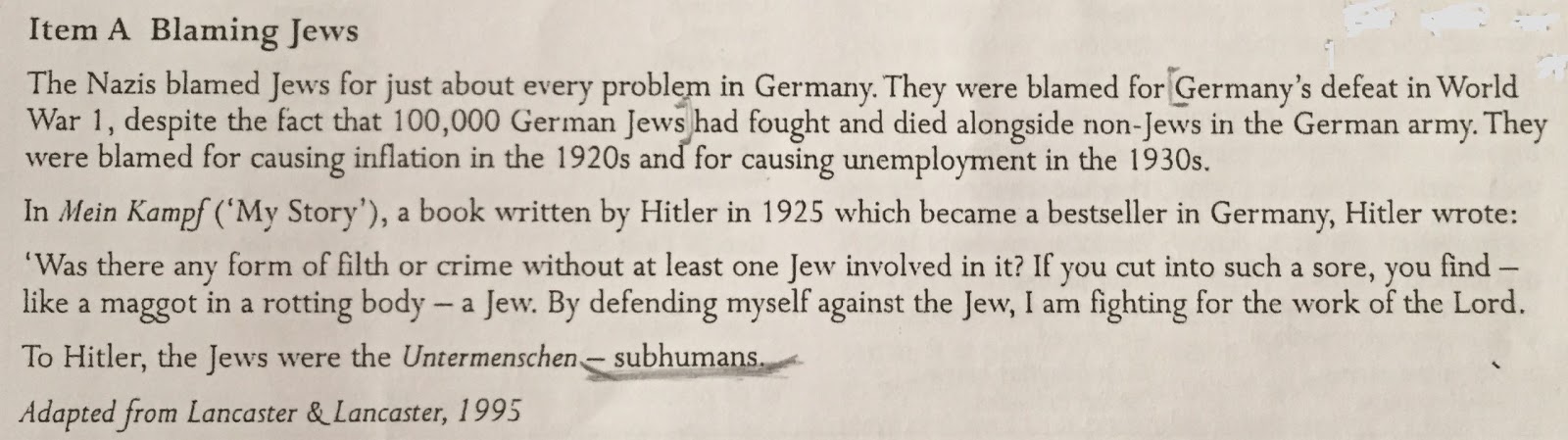
In the first set of images we can se how Hitler and the media are criticising Jews because of the misfortune of Germany after the First World War. They are shown as demons, killers and trying to poison other Germans. Hitler also blame them for the hyperinflation of the 1920's. This is a clear example of pre-judgement, which helped Hitler to turn Germans against the Jews. These judgements are senseless as the Jews fought alongside other Germans during the defeat of the First World War. This images also overplay what the Jews did, as people do not make sausages out of rats or drain the blood of other people. Those sources are not showing how Jews really are. This sources are not credible as they are all based on hate feelings towards the Jews.


The second activity is about a British propaganda during the Gulf War of 1990-1991, between the Allies and Iraq. In this source the British describe themselves in a good and heroic way, meanwhile Saddam Hussein is shown as an evil person. This source is biased as the British show themselves as if they were going yo save the world.

Wrongful Conviction

Michael Kenneth McAlister was wrongful convicted in 1986 after being recognised by the victim as the man who attempted to rape her. McAlister was then released in 2015 as the man who attacked the woman, Norman Derr, confessed his crime.

jueves, 27 de octubre de 2016

Grito de Ayuda e Igualdad

En los últimos meses la tasa de femicidios en Argentina se incrementó rápidamente. Se habla de femicidios ya que no sólo se habla de homicidios en la sociedad, sino que además de matar, se nos viola y maltrata a las mujeres solo por ser, ni más ni menos, que MUJERES. Agrupaciones feministas y de derechos humanos y el grito colectivo #NiUnaMenos se unieron y llamaron a un paro de mujeres el día miércoles 19 de octubre. En este día mujeres de toda la Argentina que quisieron participar en la causa vistieron de negro y durante una hora del mismo día se invitó a cesar toda actividad por parte de las mujeres.
El Miércoles Negro en el Colegio nos juntamos en cursos de a dos y junto con los profesores analizamos diversos casos de cómo se le educa a la mujer y al hombre y al finalizar nos propusieron realizar carteles relacionados con el tema para pegarlos por los pasillos del colegio. Acá hay algunos de los que más me llamaron la atención y hacen una reflección de lo que ocurre con las mujeres en la actualidad.
Actualmente cada vez que una mujer es asesinada, violada o golpeada se lo justifica por la ropa que llevaba puesta en el momento, por dónde iba caminando, si iba sola o provocativa. Tristemente la realidad es que se nos mata, viola y maltrata por ser mujeres, el hecho de cómo nos vestimos, por dónde vamos y cómo vamos no justifica lo que nos hacen. Los pretextos que utilizan para justificar los femicidios se les queda en la mente a muchos, que después dicen que si la mataron fue porque estaba vestida para provocar, o que ella estaba caminando por donde no debía, y no, la realidad es que nos matan por matar. La sociedad tiene una idea errónea de cómo ven a las mujeres y cómo se las tiene que tratar.


martes, 16 de agosto de 2016

The Importance of Being Earnest

"The Importance of being Earnest" is a play written by Oscar Wilde. This is a trivial comedy about the importance of being "Earnest" in high social class in the Victorian era. Through this essay how Oscar Wilde makes this piece of the play such a delightfully comic moment will be analysed by using the reactions of the characters, role reversal and the language used.
In this extract we can see how Wilde uses role reversal as to make it a comic  moment. We mainly find role reversal in the play in Lady Braknell. She is everything a man is supposed to be in charge of at that era. In this part there is a role reversal between Lady Bracknell and Jack. In the first and second act we can see Jack respecting Lady B. however, in the third one Jack feels he has more power than her and interrupts her and discusses with her. When Jack replies "I decline to give my consent" to Lady B. is very well shown he is the one with power.
We can also see how Oscar Wilde makes this piece of the play comic by the reactions of the characters and the language used. One way he makes it comis is how they change the conversation subject; they were talking about Algernon's disgraceful deception and all of a sudden they were talking with and about Cecily. "Untruthfull! My nephew Algernon? Impossible! He is an oxonian" said Lady B. and after discussing about Algernon she called Cecilia "[to Cecily] Come here, sweet child [Cecily goes over] How old are you, dear?". Wilde also shows comedy when Algernon says he could wait Cecily until  she is 35, however it was absurd because no one could wait 17 years to get married.
Throughout this essay the different ways Oscar Wilde uses as to make this piece of the play such a delightfully comic moment had been explaines. How he uses hipocrecy in the play let the reader to find this play a comic piece of writing.
domingo, 5 de junio de 2016

Allons á l' Alliance

Le mercredi 18 avril, nous sommes allés à l’Alliance avec notre classe. Nous sommes commencé le tour dans la médiathèque, on a fait des activités, on a lu des livres et pris des photos. Aprèsnous nous attendons à une classe de la compréhension de l’oral, où on a regardé une vidéo, nous avons parlé avec un professeur, elle était très patiente et elle nous a posé des questions.
Nous sommes passés une journée de merveill!

Mostrando IMG-20160518-WA0020.jpgMostrando IMG-20160519-WA0003.jpgMostrando IMG-20160518-WA0005.jpg

martes, 10 de mayo de 2016

Critical Thinking

Critical Thinking analyse and evaluate arguments. Arguments consists of a reason or reasons which support a conclusion and are designed to persuade someone about something. As to persuade it is necessary to use evidence to support it. The credibility of the evidence has to be judged (credible=believable). The evidence is taken from sources (a person, an article, a tv show, etc.)
There are many techniques which can be used to make the argument credible using sources and the evidence it provides, named credibility criteria, such as:
  • Neutrality: the neutrality of a source shows it is impartial, it does not take sides. It has no motive to lie, distort evidence or to present information that supports only one side. They are the most reliable sources or evidences.
  • Vested Interest: Someone, a person or organization, gain something from defending one point of view. Information would, probably, be distorted, they would ignore certainly evidence as to benefit themselves. Anyhow, if they have a vested interest it does not mean they are lying.
  • Bias: Is sometimes a consequence of Vested Interest. Bias is favouring certain point of view, seeing things in a particular way.
  • Expertise: We usually believe most things experts say. Training, knowledge, skills, and experience make them credible sources. Experts are humans so they may be wrong.
  • Reputation: We tend to believe sources that have a high reputation. Despite reputation doesn’t mean that the information is reliable.
  • Observation and eyewitness accounts: Eyewitnesses are usually more credible than second hand or hearsay evidence. This is due to the fact that eyewitnesses saw the event and it tends to be more reliable. As to consider its credibility it needs to be evaluated.
  • Corroboration: They are the pieces of evidence that support each other and it actually increases the credibility of evidence. However, for example, if people are feared or threatened they may lie.
  • Selectivity and representativeness: Evidence is usually selective due to its vast amount. Some groups or associations select evidence that only supports their view. We have to ask to ourselves: What kind of evidence is selected? Does it represent only one side?
  • Context: Context means the setting or situation where the evidence is produced. It’s very important to have context as to judge the quality of evidence.
As to conclude, if we combine credibility criteria we can improve the assessment of the credibility of the evidence. Knowing how to compare credibility and truth is also important. Something that is credible does not mean true, it's just believable. While true is accurate and correct. The evidence, for example can be believable but not truth.

sábado, 7 de mayo de 2016

Rape

In pairs we had to make a presentation about an issue around the world. With my mate we chose to talk about rape. We did a prezi showing images and phrases, were some people can feel identified with, or can associate them to rape. Nowadays many girls are being raped without saying a word. Men believe they can do whatever they want with girls and their bodies, but they just CAN NOT. Women get blamed whenever they are raped, either for the way they dress/were dressed or where they were walking or doing. When a women is raped nothing is the same again. It is a big trauma that changes their life forever and, sadly, there is no return for this. They are not just raping you, they are violating your rights, and you have to fight for them. We all have the rights of dressing the way we want, without have the purpose of provoking men. If you were raped talk about it, it is not possible to live with such a big thing, there is always someone you can talk about it. 

Mi CV